SCREENINGS
- Surplus Cinema IMAGINING ACTION at Beursschouwburg, Brussels, November 2022
- 3rd INTERNATIONAL ECOPERFORMANCE FILM FESTIVAL, São Paulo, May 2023
- AQUA ARDENS, Amsterdam, February-March 2024
Surplus Cinema invited us to convene around contemporary films, moving image and sound made by women-identifying, femmes and non-binary artists working in or near the context of Greece and its intertwining diasporas. The travelling programme gathers artists, filmmakers, writers, activists, thinkers and cultural workers to share questions around collaborative filmmaking practices (‘filming with’), camera work as care work and cinema as community action. It centers on intergenerational herstories, interrogations of the tourist gaze, filmmaking as activism, collectively authored cinema and works that strive towards decolonizing archives and memories.
Through humour and code-mixing, diasporic sisterhoods, afro confessions, queer joy and mourning, rerooting rituals, cinematic nests and sensory pleasures, this programme seeks to bridge communities and celebrate metasporic ones. Surplus Cinema echoes lived – unresolved, diasporic, wished – experiences.
Surplus Cinema is in conversation with Dimitra Kotouza’s book Surplus Citizens (2019) which analyzes the ‘superfluousness of subordinate classes’ within the context of the Greek ‘crisis’, alongside the transformative and subversive potential of collective action. Surplus means beyond the dominant or ‘acceptable’ ways of being, living and making.
In many of the films there is a questioning of national identity, reframing stale notions of peoples or narratives in this small border region, between East and West; a borderland, so often used as a pillar to define (and exclude from) the ‘European’. Surplus Cinema questions this very pillar by asking: How might feminist diasporic filmmaking operate as a gesture of unweaving oppressions to create spaces of non-hierarchical solidarity and healing? How can camera work be care work?
With a love of hybrid, handmade, messy and minor filmmaking, Surplus Cinema is an ongoing process of making space for crafting cinema as a placemaking and space-taking practice where we can nourish, dream and experience joy together in liberatory ways.
The 3-day programme includes screenings, public discussions with visiting and local filmmakers, a looped screening programme, a workshop and a mistressclass veered at decentering eurocentricism and engaging in feminist lineages of the moving image.
The programme for this first iteration of Surplus Cinema is conceived by Maria Christoforidou, Rabab El Mouadden, Christina Phoebe and Elli Vassalou.
RITUAL FOR A BURNT FOREST, Mouries collective, GR, 2022, 16′
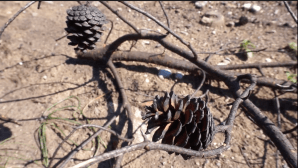
Some quotes about Ritual for a Burnt Forest from Women’s Film Heritage: Emancipating the World’s Film Archives publication
Chapter 8 –
Surplus Cinema : Feminisms and Filmmaking in the Context of Greece and its
Intertwining Diasporas
Maria Christoforidou, Sofia Dati, Rabab El Mouadden, Christina Phoebe, Elli Vassalou
(M)othering
– Rabab El Mouadden
That pain and suffering does not only affect humans but non-humans as well.
This reconnection with nature can happen, for instance, by placing focus on the forest. In Ritual for A Burnt Forest (2022), Mouries Collective makes a ritual for a forest that was taken by fire in the Greek island of Evia in 2021. Forest, or more generally Earth, is associated with mother as a life-giving entity that is exploited. Instead, in the film, the forest -the earth, the land – is not only there to be observed; she becomes a subject. Since non-humans have always been in the margins of cinema and cultural representation, I begin to wonder what a non-human cinema could be, and how we can imagine it.
an archive of errrrors
— maria christoforidou
To underline these scenes comes Ritual for a Burnt Forest, perhaps itself a malfunction in the archive. In one scene, as the collective is performing rituals to support the lost forest in their regeneration process, bodies come into the frame to gently bestow on a burnt tree body, kisses, strokes, silent wishes, and quietly leave. The ritual as unwavering, methodical, psychological labour with unquantifiable results is a glitch challenging official technological knowledge and labour. Donna Haraway’s call for new stories to call forth new worlds manifests in Mouries’ psychodynamic refusal of the expected work. Rather than digging or cutting, it glides, bringing hope to the post-apocalyptic atmosphere. Before, after and during the apocalypse there is repair and care. The ritual counteracts the deluge of news images of the fire, suggesting another story.
Landmarks and Placeholders
– Sofia Dati
…Let us circle back to Mouries collective, and linger a little longer in the company of the burned forest. Let us be with those bodies devoted to the ashy landscape of Evia. Listen to their silent song as they caress the land and gather in remembrance of an interrupted life cycle. In their collective gesture, Mouries Collective re-members, re-collects, and re-roots the forest. In their attempt to connect with their wounded surroundings, they navigate the landscape as a frontier space, a place of death and regeneration. Ritual for a Burnt Forest is a testimony to how the body archive stores and transforms dispersed traces travelling through open pores and spores. It is in such dispersion that Surplus Cinema started making its nest, thinking about diasporic kinships and metaspora. How to imagine the diasporic not as a stigma imposed on us, but as a condition of circulation, of multiple rootings and rerootings across the suffocating confines of nation, gender, and identity constructs? As symbolic representations of a place or a nation-state, landmarks constitute a collection of traces or imprints that history deemed worthy of preservation. As such, they are inseparable from notions of borders and boundaries. The forest is one such landmark. Romanticism has depicted forests as one of its preferred motifs. A whole tradition reveres those sublime wanderings in the wilderness, in that place of uncontaminated authenticity – remember Sawsan’s and Rabab’s thoughts about the hiker and the fugitive? Mouries’ ritual, however, amplifies through performance a process of co-becoming that exceeds those romantic ties to the preservation of nature as a nationalist drive.
 Mouries Collective